Total solar eclipse of 2 August 2027: where and when to see it, city by city
On Monday 2 August 2027 the Moon will completely cover the Sun along a path from southern Spain across North Africa, Egypt and Saudi Arabia to Yemen, with up to 6 minutes 23 seconds of darkness near Luxor. Here are the times for 43 cities, total and partial.
The short answer
- Date: Monday 2 August 2027 (29 Safar 1449 in the Umm al-Qura calendar). Greatest eclipse at about 10:07 UTC near Luxor, Egypt.
- Total in: southern Spain and Gibraltar, northern Morocco, Algeria, Tunisia, Libya, Egypt, western Saudi Arabia (Jeddah, Mecca), Yemen and the tip of Somalia.
- Longest totality: 6 minutes 23 seconds near Luxor (NASA). Luxor: totality 13:02–13:08 local time.
- Mecca and Jeddah: totality 13:24–13:29 and 13:22–13:28 local time.
- Partial everywhere around: Europe, North and East Africa, the Middle East and Pakistan; London sees about 41.7% of the Sun covered.
- Safety: look only through ISO 12312-2 eclipse glasses, except during the minutes of totality.
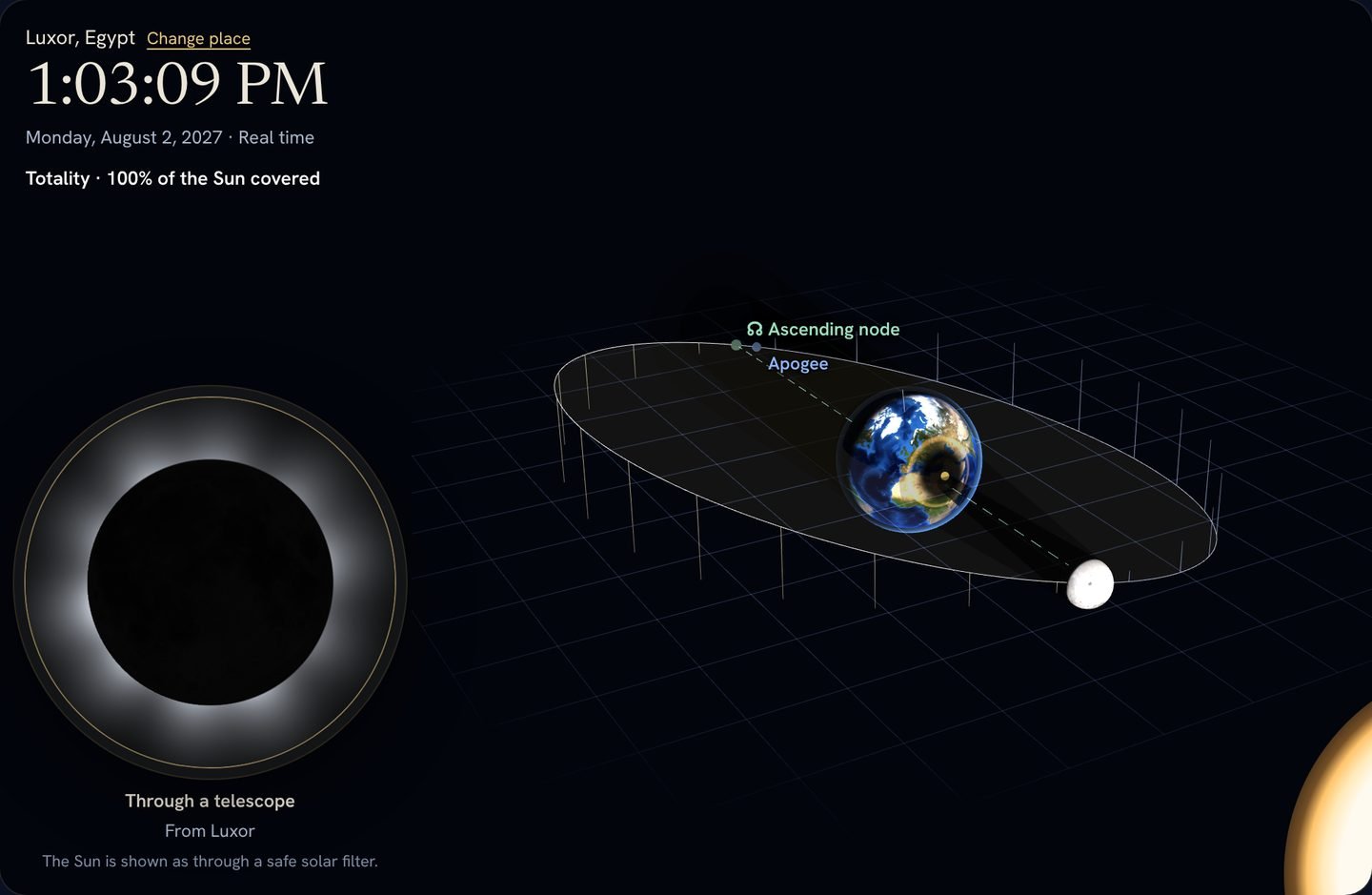
Where the eclipse is total
The Moon’s full shadow, the umbra, covers only a narrow band where it touches the Earth. It enters land at the Strait of Gibraltar in mid-morning, crosses North Africa and Egypt around midday, reaches Saudi Arabia and Yemen in the early afternoon and leaves land at the tip of Somalia. Outside this path the eclipse is only partial, and even 99% coverage is very different from totality: only inside the path does the sky go dark and the corona appear.
The times below are in local time and rounded to the minute. The length of totality is rounded to the nearest 10 seconds. Near the edge of the path it changes quickly over a few kilometres, which is why Málaga gets less than two minutes while Gibraltar, about 100 km away, gets more than four.
| City | Country | Totality (local time) | Length | Sun’s height |
|---|---|---|---|---|
| Cádiz | Spain | 10:45–10:48 | about 2 min 50 s | 37° |
| Gibraltar | Gibraltar | 10:45–10:50 | about 4 min 20 s | 38° |
| Málaga | Spain | 10:48–10:50 | about 1 min 40 s | 39° |
| Tangier | Morocco | 08:45–08:49 | about 4 min 50 s | 38° |
| Tétouan | Morocco | 08:45–08:50 | about 4 min 50 s | 38° |
| Oran | Algeria | 09:51–09:56 | about 5 min 10 s | 43° |
| Chlef | Algeria | 09:54–09:59 | about 4 min 30 s | 45° |
| Sfax | Tunisia | 10:09–10:14 | about 5 min 40 s | 56° |
| Benghazi | Libya | 11:28–11:34 | about 6 min 10 s | 68° |
| Luxor | Egypt | 13:02–13:08 | about 6 min 20 s | 82° |
| Sohag | Egypt | 12:59–13:05 | about 6 min 20 s | 81° |
| Jeddah | Saudi Arabia | 13:22–13:28 | about 6 min | 76° |
| Mecca | Saudi Arabia | 13:24–13:29 | about 5 min | 76° |
| Abha | Saudi Arabia | 13:34–13:40 | about 6 min | 71° |
| Jazan | Saudi Arabia | 13:38–13:41 | about 3 min | 70° |
| Sanaa | Yemen | 13:44–13:47 | about 2 min 30 s | 67° |
| Bosaso | Somalia | 13:58–14:02 | about 4 min | 58° |
Egypt and Saudi Arabia: the longest and highest
The longest totality on Earth, 6 minutes 23 seconds by NASA’s calculation, comes in Upper Egypt near Luxor, where the Sun is 82° high, almost overhead. Jeddah, Mecca and Abha all have five to six minutes of totality with the Sun above 70°. On the Atlantic side, in Spain and Morocco, the eclipse happens in the morning with the Sun about 38° high.
A partial eclipse across Europe, Africa and the Middle East
Anyone within a few thousand kilometres of the path sees a partial eclipse. The figure in the last column is the share of the Sun’s disc hidden at maximum. Tripoli lies just outside the edge of the path: we find 99.9%, so the Sun is never completely covered there.
| City | Begins | Maximum | Ends | Sun covered |
|---|---|---|---|---|
| Seville | 09:41 | 10:47 | 12:00 | 98.3% |
| Madrid | 09:45 | 10:51 | 12:03 | 86.2% |
| Lisbon | 08:41 | 09:45 | 10:55 | 92.4% |
| London | 09:04 | 10:00 | 10:59 | 41.7% |
| Paris | 10:01 | 11:01 | 12:05 | 51.1% |
| Rome | 10:02 | 11:13 | 12:27 | 74.4% |
| Istanbul | 11:27 | 12:39 | 13:51 | 59.3% |
| Casablanca | 07:38 | 08:44 | 09:57 | 97.1% |
| Rabat | 07:39 | 08:45 | 09:59 | 98.5% |
| Algiers | 08:48 | 09:59 | 11:16 | 99.8% |
| Tunis | 08:56 | 10:10 | 11:29 | 96.9% |
| Tripoli | 10:00 | 11:17 | 12:38 | 100% |
| Cairo | 11:33 | 12:56 | 14:16 | 94.6% |
| Alexandria | 11:30 | 12:52 | 14:12 | 93.3% |
| Medina | 11:57 | 13:21 | 14:38 | 94.4% |
| Riyadh | 12:14 | 13:32 | 14:45 | 75.7% |
| Amman | 11:42 | 13:02 | 14:18 | 78.2% |
| Baghdad | 12:01 | 13:14 | 14:23 | 55.4% |
| Kuwait City | 12:12 | 13:26 | 14:35 | 58.8% |
| Doha | 12:24 | 13:39 | 14:46 | 61.9% |
| Dubai | 13:34 | 14:44 | 15:48 | 53.4% |
| Muscat | 13:43 | 14:50 | 15:52 | 50.1% |
| Khartoum | 10:57 | 12:23 | 13:42 | 70.9% |
| Aden | 12:28 | 13:51 | 15:06 | 96.1% |
| Nairobi | 12:52 | 14:01 | 15:04 | 30.7% |
| Karachi | 15:01 | 15:57 | 16:49 | 29.4% |
How to watch it safely
Use eclipse glasses or a hand-held solar viewer that meets the ISO 12312-2 standard; ordinary sunglasses, however dark, are not safe. Binoculars, cameras and telescopes need a proper solar filter fitted on the front, never at the eyepiece. Only during totality, when the Sun is completely hidden, is it safe to look without protection, and the glasses must go back on the moment the first bright point of the Sun reappears (NASA). In a partial eclipse there is no safe moment without protection.
Watch it in our simulator
Open the live sky from Luxor on the morning of 2 August 2027 and press play, or open the Eclipses page, choose the solar eclipse of 2 August 2027 and pick your own city to see the times and how much of the Sun is covered from there.
Questions people ask
When is the total solar eclipse in 2027?
On Monday 2 August 2027. Greatest eclipse is at about 10:07 UTC near Luxor in Egypt, and the Moon’s full shadow takes about three and a half hours to cross the Earth, from the Atlantic to the Indian Ocean.
Where will the 2 August 2027 eclipse be total?
In a narrow band across the southern tip of Spain and Gibraltar, northern Morocco, Algeria, Tunisia, Libya, Egypt, the Red Sea, western Saudi Arabia, Yemen and the tip of Somalia. The table above lists the times in 17 places.
How long will totality last?
Up to 6 minutes 23 seconds, the longest anywhere, near Luxor (NASA). Our figure for Luxor is about 6 minutes 20 seconds; Jeddah has about 6 minutes, Mecca about 5 minutes and Gibraltar about 4 minutes 20 seconds.
Will the eclipse be total in Mecca and Jeddah?
Yes. In Mecca the Sun is completely covered from about 13:24–13:29 local time, and in Jeddah from about 13:22–13:28, with the Sun high in the sky.
Can I see the eclipse from the UK?
Only as a partial eclipse. In London the Moon covers about 41.7% of the Sun at 10:00 BST; the eclipse lasts from 09:04 to 10:59.
Is it safe to look at the eclipse?
Only with proper eclipse glasses or viewers that meet the ISO 12312-2 standard; ordinary sunglasses are not safe. Cameras, binoculars and telescopes need a solar filter on the front. You may look without protection only during totality, when the Sun is completely covered, and must put the glasses back on as soon as it ends (NASA).
When is the next total solar eclipse after this one?
On 22 July 2028, across Australia and New Zealand.
How we calculated this
Positions of the Sun and Moon from Astronomy Engine for each city’s position and height. The start and end of totality use the lunar radius NASA uses for these contacts (0.272281 Earth radii), so our durations agree with NASA’s greatest duration (6 min 23.2 s) and, for cities on the central part of the path, with timeanddate.com to within about 3 seconds. Near the edges of the path, totality can differ by 10 to 20 seconds between sources, because it depends on the exact point chosen for a city and on the mountains along the Moon’s edge. Sources: NASA eclipse website (Espenak; greatest eclipse 10:07:49 TT, Saros 136), timeanddate.com.