Ramadan 2027 moon sighting: where the crescent can be seen on 7 February
Ramadan 1448 is expected to begin on Monday 8 February 2027. Here is where the new crescent can and cannot be seen on the evenings of 6, 7 and 8 February, city by city, by three published methods.
The short answer
- Umm al-Qura calendar (Saudi Arabia): 1 Ramadan 1448 is Monday 8 February 2027; the first taraweeh is on the evening of Sunday 7 February.
- New moon (conjunction): Saturday 6 February 2027 at 15:57 UTC, within minutes of an annular solar eclipse over the South Atlantic.
- Evening of Saturday 6 February: the crescent cannot be seen anywhere.
- Evening of Sunday 7 February: easy in the Americas and Morocco; possible by eye in a very clear sky across the Middle East, the rest of North Africa and Europe; harder in South Asia; binoculars or a telescope needed in South-East Asia; not possible in Australia.
- Evening of Monday 8 February: easy to see by eye almost everywhere.
- Eid al-Fitr: Umm al-Qura gives Ramadan 29 days, so 1 Shawwal is Tuesday 9 March 2027.
Where the crescent can be seen on Sunday 7 February
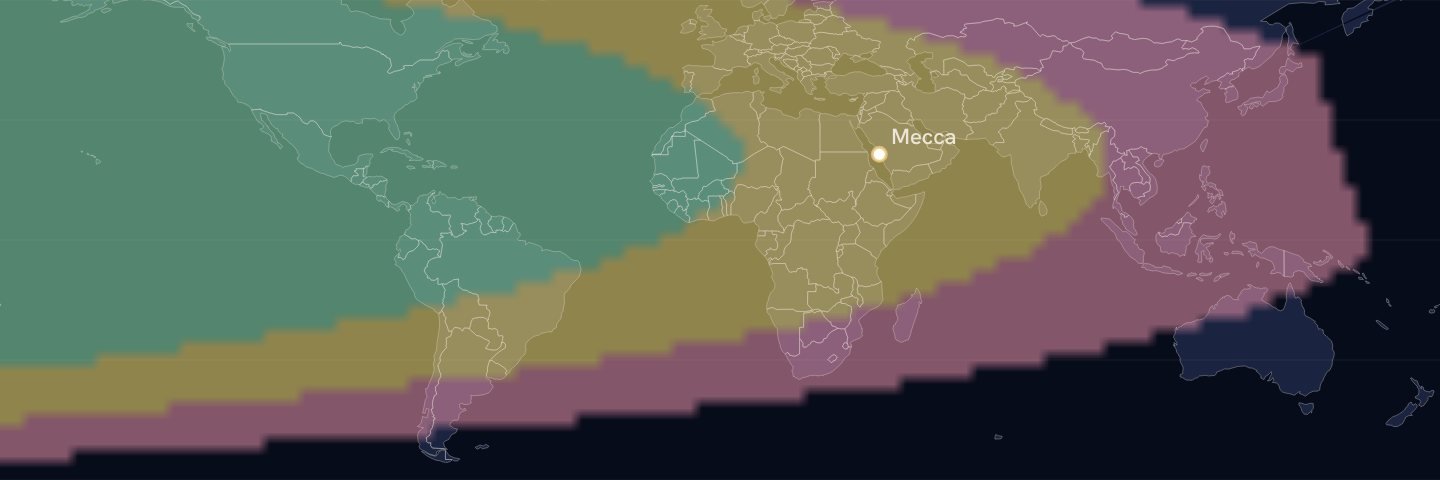
On Sunday evening the Moon is about a day old at sunset in the Middle East. In Mecca it sets about 45 minutes after the Sun. That is enough for a sighting by eye only if the air is very clear, which is why the International Astronomy Center criterion puts Mecca in zone B and the UK criterion gives category B, “visible in perfect conditions”. Further west the Moon is older and sets later: in New York it is about 30 hours old and stays up for 72 minutes, so it is easy to see. Further east it is younger: in Jakarta it sets 29 minutes after the Sun and needs a telescope, and in Sydney it sets only 17 minutes after the Sun, too soon to be seen.
City by city
The table gives the verdict for the evening of Sunday 7 February by both criteria, and for Monday 8 February. On the evening of Saturday 6 February the crescent is not possible to see in any of these cities: across Asia, the Middle East and Europe the new moon has not yet happened, or the Moon sets with the Sun, and in the Americas it is only a few hours old.
| City | Sun 7 Feb · IAC (Odeh) | Sun 7 Feb · UK (Yallop) | Mon 8 Feb · IAC (Odeh) |
|---|---|---|---|
| Middle East and the Gulf | |||
| Mecca | Possible by eye in a very clear sky | Visible in perfect conditions (B) | Easy to see by eye |
| Riyadh | Possible by eye in a very clear sky | Visible in perfect conditions (B) | Easy to see by eye |
| Dubai | Possible by eye in a very clear sky | May need optical aid (C) | Easy to see by eye |
| Doha | Possible by eye in a very clear sky | Visible in perfect conditions (B) | Easy to see by eye |
| Kuwait City | Possible by eye in a very clear sky | Visible in perfect conditions (B) | Easy to see by eye |
| Amman | Possible by eye in a very clear sky | Visible in perfect conditions (B) | Easy to see by eye |
| Baghdad | Possible by eye in a very clear sky | Visible in perfect conditions (B) | Easy to see by eye |
| North Africa and Turkey | |||
| Cairo | Possible by eye in a very clear sky | Visible in perfect conditions (B) | Easy to see by eye |
| Casablanca | Easy to see by eye | Visible in perfect conditions (B) | Easy to see by eye |
| Rabat | Easy to see by eye | Visible in perfect conditions (B) | Easy to see by eye |
| Algiers | Possible by eye in a very clear sky | Visible in perfect conditions (B) | Easy to see by eye |
| Istanbul | Possible by eye in a very clear sky | Visible in perfect conditions (B) | Easy to see by eye |
| Rest of Africa | |||
| Lagos | Possible by eye in a very clear sky | Visible in perfect conditions (B) | Easy to see by eye |
| Johannesburg | Needs binoculars or a telescope | Not visible with a telescope (E) | Easy to see by eye |
| Europe | |||
| London | Possible by eye in a very clear sky | Visible in perfect conditions (B) | Easy to see by eye |
| Birmingham | Possible by eye in a very clear sky | Visible in perfect conditions (B) | Easy to see by eye |
| Paris | Possible by eye in a very clear sky | Visible in perfect conditions (B) | Easy to see by eye |
| North America | |||
| New York | Easy to see by eye | Easily visible (A) | Easy to see by eye |
| Toronto | Easy to see by eye | Easily visible (A) | Easy to see by eye |
| Chicago | Easy to see by eye | Easily visible (A) | Easy to see by eye |
| Los Angeles | Easy to see by eye | Easily visible (A) | Easy to see by eye |
| South Asia | |||
| Karachi | Possible by eye in a very clear sky | May need optical aid (C) | Easy to see by eye |
| Lahore | Possible by eye in a very clear sky | May need optical aid (C) | Easy to see by eye |
| Delhi | Possible by eye in a very clear sky | May need optical aid (C) | Easy to see by eye |
| Mumbai | Possible by eye in a very clear sky | May need optical aid (C) | Easy to see by eye |
| Dhaka | Possible by eye in a very clear sky | May need optical aid (C) | Easy to see by eye |
| South-East Asia and Australia | |||
| Kuala Lumpur | Needs binoculars or a telescope | Will need optical aid (D) | Easy to see by eye |
| Singapore | Needs binoculars or a telescope | Not visible with a telescope (E) | Easy to see by eye |
| Jakarta | Needs binoculars or a telescope | Not visible (F) | Easy to see by eye |
| Sydney | Not possible to see | Not visible (F) | Easy to see by eye |
| Melbourne | Not possible to see | Not visible (F) | Possible by eye in a very clear sky |
Monday 8 February: easy almost everywhere
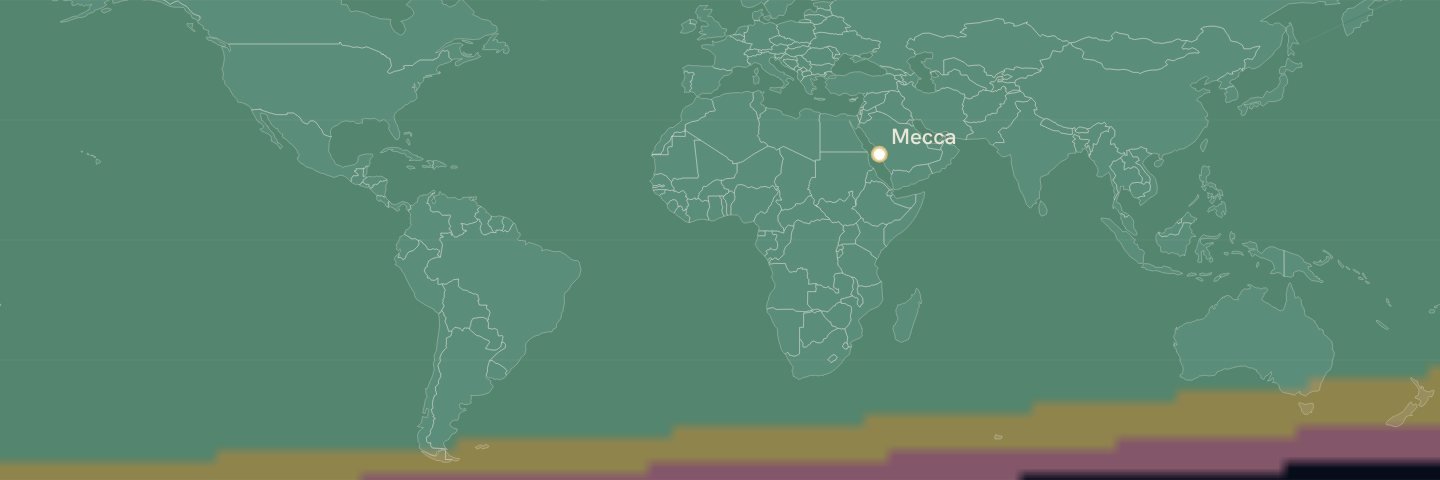
By Monday evening the Moon is about two days old and sets about an hour and a half or more after the Sun across the Middle East and South Asia, so it is easy to see by eye wherever the sky is clear. In Melbourne it is still only possible in a very clear sky.
Why some countries may start on a different day
Muslims agree on the rule, to begin the month with the new crescent, but not on how to apply it. Saudi Arabia publishes the Umm al-Qura calendar and its Supreme Court also receives sighting reports. Egypt’s Dar al-Ifta, Morocco’s Ministry of Habous and Islamic Affairs, Pakistan’s Central Ruet-e-Hilal Committee and Indonesia’s Ministry of Religious Affairs (at its sidang isbat) each decide for their own country, and in the UK and North America communities follow different authorities. Because the crescent is easier to see in the west on 7 February, places that accept a calculation or a sighting from anywhere are likely to start on 8 February. Places that need a sighting inside their own borders in South or South-East Asia may start on 9 February if the crescent is not seen. For awal Ramadhan 2027 in Indonesia and Malaysia, wait for the official announcement.
Why Ramadan is earlier every year
The Islamic year has twelve lunar months, 354 or 355 days in all, about 11 days shorter than the solar year. So Ramadan moves earlier through the seasons: in 2027 it begins in February, and Ramadan 1449 begins about 28 January 2028 in the Umm al-Qura calendar.
Watch the evening for yourself
Open the live sky for the evening of 7 February 2027 to watch the Sun set and the young Moon follow it from Mecca, then choose your own city. The Hilal page also shows the previous and next crescents for any place on Earth.
Questions people ask
When does Ramadan 2027 start?
In the Umm al-Qura calendar used in Saudi Arabia, 1 Ramadan 1448 is Monday 8 February 2027, so the first taraweeh prayer is on the evening of Sunday 7 February. Countries that wait for a local sighting may begin on 8 or 9 February.
When is the moon sighting for Ramadan 2027?
The new moon (conjunction) is on Saturday 6 February 2027 at 15:57 UTC. That evening the crescent cannot be seen anywhere. The first real chance is the evening of Sunday 7 February.
Will the Ramadan crescent be visible in the UK on 7 February 2027?
By our calculation the crescent is possible by eye in London and Birmingham in a very clear sky (IAC zone B; Yallop category B). It sets about 66 minutes after the Sun.
Will the Ramadan moon be seen in Pakistan and India on 7 February 2027?
Only just. In Karachi, Lahore, Delhi and Mumbai the crescent is possible by eye in a very clear sky by the IAC criterion, and the UK criterion says it may need optical aid. It sets about 40 to 43 minutes after the Sun. On 8 February it is easy to see.
When is Eid al-Fitr 2027?
The Umm al-Qura calendar gives Ramadan 1448 29 days, so 1 Shawwal (Eid al-Fitr) is Tuesday 9 March 2027. Where Eid depends on a sighting, it may be a day later.
Why does Ramadan start on different days in different countries?
Some countries follow a calculated calendar, some accept a sighting from anywhere, and others need a sighting in their own country. The crescent is visible earlier in the west than in the east, so a country in South-East Asia may see it a day later than one in the Americas.
Why is Ramadan earlier every year?
The Islamic year has twelve lunar months, about 354 or 355 days, which is about 11 days shorter than the solar year. Ramadan 1449 begins about 28 January 2028.
How we calculated this
Positions from Astronomy Engine for each city’s position and height; the crescent is judged at the best time to look, sunset plus four ninths of the time until moonset. Methods: Odeh (2006), used by the International Astronomy Center; Yallop (1997), used by HM Nautical Almanac Office; and the Umm al-Qura rule at Mecca. Expected dates agree with Islamic Relief and HRF, which also give the evening of 7 February for the start, and with the UAE’s Astronomy Centre as reported by Khaleej Times, which expects 1 Ramadan on 8 February and Eid al-Fitr on 9 March, or 10 March if the crescent is not seen. Read more on how we calculate. These are calculations, not sightings: for the start of the month, follow the authority your community trusts.